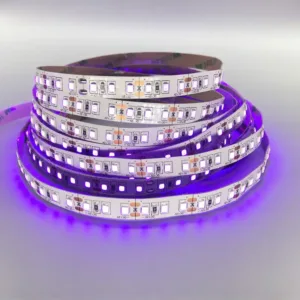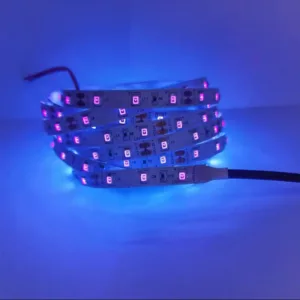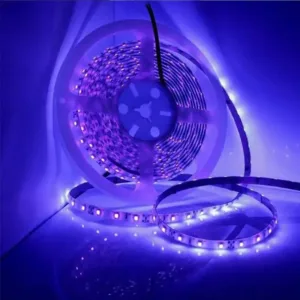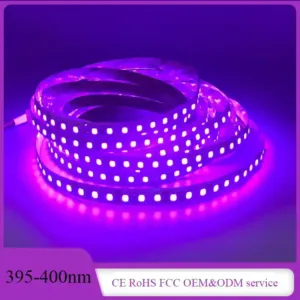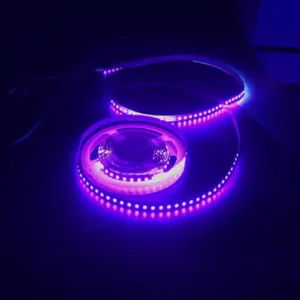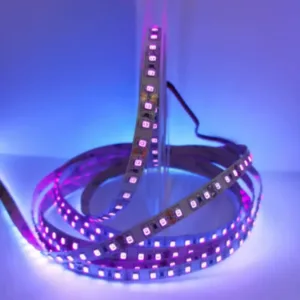
UV LED Light Strips
YOYO-UV provides UV LED light strips for fluorescence, UV curing, inspection, blacklight displays, scientific equipment and custom industrial UV systems.
Our product range includes 365nm and 395nm UVA LED strips and special UVC LED strip solutions for OEM equipment. Different LED densities, PCB widths, input voltages, waterproof structures and electrical configurations are provided according to the application.
We provide flexible UV LED strips for standard projects and complete OEM/ODM UV LED strip development for equipment manufacturers, distributors and industrial customers.
Customization can be wavelength, LED quantity, PCB size, copper thickness, input voltage, power, wiring, connectors, waterproof structure and mechanical integration.
365nm and 395nm UV LED Strips
365nm and 395nm are two of the most common wavelengths for UVA LED strips.
Though these two wavelengths belong to or close to the UVA region, they generate different visual and fluorescence effects.
365nm UV LED Strips
A 365nm UV LED strip generates smaller quantity of visible violet light than a standard 395nm strip.
Therefore, it is suitable for cases where fluorescence contrast is more important than the visible violet light.
Application areas include:
- Fluorescence inspection
- Anti-counterfeiting inspection
- UV-reactive display
- Mineral display
- Artwork inspection
- Security mark inspection
- UV dye detection
- UV adhesive curing
- Resin curing
- Laboratory equipment
- Industrial inspection
Low visible light interference is helpful to observe the weak fluorescence signal for some fluorescence applications.
395nm UV LED Strips
A 395nm UV LED strip is closer to the visible violet light region.
Generally, the strip generates a stronger purple light and is suitable for:
- Blacklight display
- UV-reactive artwork
- Stage lighting
- Entertainment lighting
- Signage
- Display cases
- Shelves
- Fluorescent display
- General inspection
- Special curing applications
395nm is relatively low-cost and suitable for some projects which do not require the low visible light interference feature of 365nm.
365nm vs 395nm UV LED Strip
There is no ideal wavelength for all applications.
Use 365nm when fluorescence contrast and low visible purple light are more important.
Use 395nm when a visible blacklight effect or good response to the 395nm light are desired.
In terms of curing application, the wavelength should be matched with the absorption feature of the ink, resin, coating or adhesive.
Testing the actual target material is advised before choosing the wavelength for large-volume production.
UVA vs UVC LED Strips
Not all of UV LED strips are developed for the same applications.
UVA LED strips, such as 365nm and 395nm LED strips, are commonly used for fluorescence, inspection, curing and blacklight applications.
On the other hand, UVC LED strips work at shorter wavelengths and are specially designed for professional controlled water, air, surface-treatment and analytical equipment.
It is wrong to present a 365nm or 395nm UV strip as the normal UVC germicidal light source.
And the UVC LED strip also requires much stricter optical safety and system validation.
UVC LED Strips for OEM Equipment
We also offer UVC LED strip solutions for manufacturers to develop their specialized ultraviolet equipment.
Linear UVC LED strips can distribute the UV emitting modules on a small area where one single concentrated LED module cannot provide the suitable geometry.
Typical applications include:
- Water-treatment equipment
- Air-treatment systems
- Enclosed surface-treatment equipment
- Laboratory instrument
- Analytical equipment
- Industrial UV equipment
For UVC applications, wavelength and electrical wattage only determine partially the final treatment efficiency.
In order to obtain the final treatment performance, other factors should also be taken into account including:
- Radiant power
- Irradiance
- Working distance
- Exposure time
- UV dose delivered
- LED spacing
- Optical geometry
- Treatment area
- Thermal conditions
The system should be tested under its real operating conditions.
LED Density: 60, 120 or More LEDs per Meter
LEDs of different densities can be installed in the UV LED strip.
Commonly used LED densities may include 60 LEDs/m, 120 LEDs/m or other customized configurations.
Higher LED density is beneficial to reduce the spacing of light sources and make the optical coverage more uniform.
But note that higher LEDs per meter does not necessarily mean higher UV output proportionally.
Other factors which influence the final performance include:
- Radiant output per LED
- Operating current
- Efficiency of the LED
- PCB design
- Strip temperature
- Power supply
- Optical configuration
For professional applications, LED density should be decided together with UV output and thermal issues.
Electrical Power vs UV Radiant Output
Electrical power and UV output are different parameters.
For example, a strip which is rated 17W/m uses approximately 17 watts of electrical power per meter under its stated operating condition.
It does not mean the strip can deliver 17 watts of ultraviolet optical energy.
For professional evaluation, useful data may include:
- Electrical power in W/m
- Radiant power in mW or W
- Irradiance in mW/cm²
- Measurement distance
- Irradiation area
- Peak wavelength
Optical data can give you more useful information than the electrical wattage.
UV Irradiance and Working Distance
UV irradiance refers to the quantity of UV energy received by a certain surface area.
It should always be considered together with the measurement distance.
One same UV LED strip can generate different values of UV irradiance at 5cm, 15cm and 50cm distance.
Factors influencing the irradiance of UV LED strips include:
UV output + LED spacing + beam angle + optics + working distance + target area
For OEM projects, please tell us the working distance and irradiation area of target whenever possible.
This helps you choose the proper LED density and strip configuration.
SMD2835 and SMD3535 UV LED Strips
LEDs of different packages can be chosen according to wavelength and UV output requirements.
SMD2835 UV LED strips are widely used in UVA LED strips where a slim PCB, high LED density and flexible installation are important.
For higher UV output or shorter wavelength applications, other LED packages such as SMD3535 can be used.
The right package is decided by wavelength, UV output, current, thermal issues and PCB space.
Narrow UV LED Strips
Some equipment has limited space for installation.
In these projects, a narrow UV LED strip can be used as an efficient light source for thin aluminum channel, edge of cabinets and other equipment housings and compact optical systems.
The width of PCB can be customized according to your design.
If narrowing the width of the strip, electrical current and thermal performance should also be considered.
The narrow strip with high power density may have better heat dissipation than a wide one with low power density.
PCB Copper Thickness and Thermal Management
Thermal management is significant for high-density and high-power UV LED strips.
The PCB serves as the thermal path and electrical circuit.
Important factors for thermal management include:
- PCB width
- Copper thickness
- LED density
- Electrical current
- Power per meter
- Mounting surface
- Ambient temperature
- Continuous operating time
Thick copper can enhance both electrical and thermal conduction, but the whole installation should have proper thermal path for the heat to be transferred out of the strip.
For higher-power applications, mounting the strip to an aluminum profile or other heat conductive structure can be helpful for temperature control.
5V, 12V and 24V UV LED Strips
UV LED strips can be designed for different input voltages.
They can include:
- 5V
- 12V
- 24V
Depending on strip length, power density, control system and equipment design, different input voltages can be suitable.
5V is useful for short compact products and USB applications.
12V is generally used in LED equipment.
24V can be used in long strip runs as it can save electrical current for the same electrical power and minimize voltage drop.
The power supply should match the strip voltage.
Voltage Drop in Long UV LED Strips
Voltage drop will happen in long LED strips.
It will become more serious with:
- Higher LED density
- Higher power per meter
- Longer continuous strip length
- Lower operating voltage
- Higher current
Too large voltage drop will lead to different operations between the far end and the end near the power supply of one same strip.
To solve the issue, the solutions can include:
- Using 24V rather than lower voltage design
- Shortening each power-feed section
- Feeding power to both sides of the strip
- Adding power injection point
- Choosing proper copper thickness
- Choosing the right wire size
For OEM projects, please tell us your required strip length and power architecture so that we can evaluate the electrical layout before production.
IP20, IP65, IP67 and Custom Waterproof UV Strips
UV LED strips can have different environmental protection structures.
IP20 is usually suitable for dry indoor environment or equipment with protection measures.
Higher protection level can be used for outdoor installations or any other environments where moisture, splash water or other environmental conditions are involved.
Waterproof encapsulation will influence the heat dissipation and optical transmission and the protection level should be decided together with the thermal and UV output issues.
For customized projects, please tell us whether the strip is for indoor, outdoor, humid air, water or enclosed equipment.
UV LED Strips for Curing
UV LED strips can be used for selected curing applications involving:
- UV adhesives
- Resins
- Inks
- Coatings
- Electronics assembly
- Industrial bonding
Right wavelength will depend on the photoinitiator and target material.
Neither 365nm nor 395nm can cure all materials efficiently.
For production equipment, wavelength, irradiance, exposure time and working distance should be evaluated together.
It is advised to test the actual curing material before choosing the UV LED strip.
UV LED Strips for Fluorescence and Inspection
Flexible UV LED strips are useful when UV excitation needs to be distributed in a longer area rather than concentrated into a flashlight-like beam.
Applications include:
- Fluorescence inspection
- Security printing
- Anti-counterfeiting system
- UV-reactive display
- Artwork
- Mineral display
- Optical inspection
- Industrial inspection
365nm is commonly chosen for the case when the interference of visible violet light is minimized.
395nm can be used when both fluorescence and visible blacklight are needed.
UV LED Strip Safety
UV radiation is not the same as the normal visible light.
Do not expose unnecessarily to eyes and skin directly.
Professional UV equipment should be designed according to wavelength, irradiance, exposure time and intended application.
According to the specific application, it should have some safety measures including:
- UV shielding
- Enclosed light path
- Protective eyewear
- Safety interlock
- Automatic shut-off
- Warning label
- Controlled access
Especially the UVC system requires very strict safety measures as direct exposure of UVC light can harm the eyes and skin.
The equipment manufacturer should evaluate the photobiological safety of the product.
Custom OEM & ODM UV LED Light Strips
We offer OEM and ODM UV LED light strips for equipment manufacturers, distributors, engineering companies and product developers.
Customized UV LED strips can be:
- UV wavelength
- LED brand and model
- LED quantity
- LED density
- PCB width
- PCB thickness
- Copper thickness
- Input voltage
- Electrical power
- Radiant output
- Strip length
- Cutting length
- Beam angle
- Wiring
- Connectors
- Waterproof structure
- Adhesive backing
- Control method
- Packaging and private labeling
We can develop flexible strips, narrow PCB strips, high-density UV strips and specialized UVC LED strip assemblies according to your equipment requirements.
What Information Do We Need for a Custom UV LED Strip?
For OEM projects, please provide:
- Wavelength needed
- Application area
- Length of strip
- PCB width available
- LED density needed
- Input voltage
- Required UV output or irradiance
- Working distance
- Irradiation area
- Waterproof requirement
- Continuous or intermittent operation
- Wiring and connectors
If some parameters are not clear now, just tell us the application, installation space and wavelength.
Our engineers can suggest a proper UV LED strip configuration for prototype development.
Whether you need a narrow 365nm UV LED strip, high-density 395nm blacklight strip, customized 5V/12V/24V flexible strips or specialized 275nm UVC LED strip, YOYO-UV can provide OEM and ODM development from sample production to volume manufacturing.
Showing all 8 results

365nm Black Light LED Strip 120LED/m
$0.00365nm Black Light Strips 120LED/m
$0.00365nm UV Light Strip 5mm 60LED/m
$0.00365nm UV Strip Light 8mm 60LED/m
$0.00395nm Black Light LED Light Strips 5mm
$0.00395nm Black Light LED Tape 8mm
$0.00395nm UV LED Strip 8mm 120LED/m
$0.00395nm UV LED Strip Lights 5mm 120LED/m
$0.00