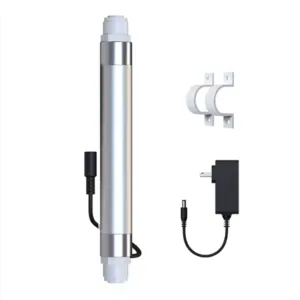
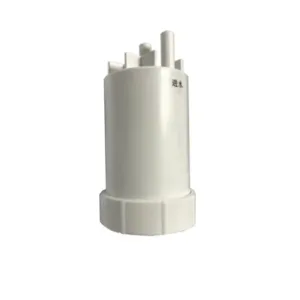
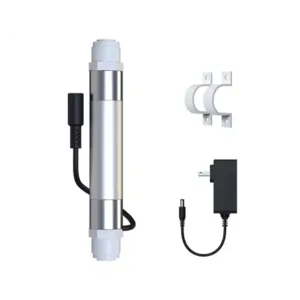
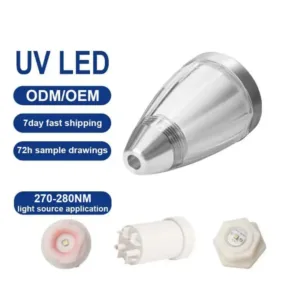
YOYO-UV is a manufacturer of UV lights for water treatment, specializing in compact UVC LED water disinfection modules and UV water treatment systems for OEM and ODM applications.
Our products are designed for integration into drinking-water equipment, point-of-use water purifiers, water dispensers, RV and yacht water systems, commercial equipment and other water-treatment products.
We offer UVC LED solutions at wavelengths such as 265nm and 275nm, with different flow rates, UV outputs, voltages, housing structures and water connections available for custom projects.
From a small UVC LED module to a complete inline UV water sterilizer, our factory can develop a solution around your water path, flow rate and equipment requirements.
How Does UV Water Treatment Work?
UV water treatment uses ultraviolet energy to inactivate microorganisms as water passes through an irradiation area.
UVC light reaches microorganisms in the water and damages their genetic material, reducing their ability to reproduce.
Unlike chemical disinfection, UV treatment does not need to add a disinfecting chemical directly to the water.
However, UV water treatment is not the same as water filtration.
UV is mainly used for microbial control. It does not directly remove sediment, sand, hardness, heavy metals, scale or most dissolved chemicals.
For this reason, UV is often used as one stage in a complete water-treatment system.
UVC LED Water Treatment
Traditional UV water systems commonly use germicidal UV lamps.
For compact equipment, UVC LED water treatment offers another option.
UVC LEDs can provide a small UV light source that is easy to integrate into limited installation spaces.
Common advantages for OEM designs include:
Compact module size
Instant on/off operation
Low-voltage DC options
No mercury inside the LED
Flexible LED arrangement
Custom PCB and optical design
Flow-sensor control options
Easy integration into compact water paths
Our UVC LED water treatment products are available for different equipment structures and operating conditions.
The best technology depends on the required flow rate, UV dose, installation space, operating time, maintenance target and product cost.
265nm and 275nm UVC LED Water Treatment
We provide 265nm and 275nm UVC LED water treatment solutions for different OEM applications.
The wavelength is important, but it should not be used as the only parameter when selecting a UV water disinfection system.
Engineers should also consider:
Radiant power
Irradiance
UV dose
Flow rate
Exposure time
UV transmittance
Water quality
Chamber geometry
LED position
Thermal management
Two UV water treatment devices using the same wavelength may provide different results if their flow rate, optical design or water conditions are different.
Understanding UV Dose
Electrical wattage alone does not tell you how much useful UVC energy reaches the water.
Three terms are important.
Radiant power describes the total optical UV output from the light source.
Irradiance describes the UV power reaching a specific area.
UV dose depends on the UV irradiance delivered over a period of time.
For flowing water, exposure time is affected by the water velocity and reactor design.
This is why a higher flow rate cannot automatically be used with the same UV module while expecting the same treatment performance.
The complete water path should be evaluated as a system.
Why UVT Matters in UV Water Treatment
UV transmittance, or UVT, describes how well UV light can pass through the water.
Clear water with good UV transmission allows UVC energy to penetrate more effectively.
Particles, turbidity, color and some dissolved substances can reduce the amount of UV energy reaching microorganisms.
For professional UV water treatment projects, flow rate alone is therefore not enough to select the correct system.
When possible, consider:
Water source
Turbidity
UVT
Iron and mineral conditions
Flow rate
Required treatment target
If the source water has sediment or high turbidity, suitable pre-filtration should normally be considered before the UV stage.
Point-of-Use UV Water Treatment
Compact point-of-use UV water treatment is one of the main applications for UVC LED technology.
Typical applications include:
Under-sink water purifiers
Faucet water treatment
Water dispensers
RO purifier outlets
Drinking-water machines
Coffee and beverage equipment
Compact kitchen appliances
A small UVC LED module can be positioned close to the final water outlet, allowing manufacturers to add a controlled UV disinfection stage without installing a large traditional UV chamber.
We can customize module dimensions, water interfaces, voltage, wiring and control methods according to the final device.
Point-of-Entry and Higher-Flow UV Systems
Point-of-entry systems treat water before it is distributed to multiple outlets.
These applications can include:
Homes
RVs
Yachts
Small commercial buildings
Farms
Hospitality equipment
Light industrial systems
Higher-flow applications require careful sizing.
Increasing LED power alone is not always enough. Chamber dimensions, residence time, UV distribution, water quality and thermal management also affect system performance.
We offer different water treatment structures for low- and medium-flow OEM applications and can evaluate customized designs according to project requirements.
UV Water Treatment for RVs and Yachts
Low-voltage UV water treatment systems for RV and yacht applications can be developed for mobile water systems where installation space and electrical power are limited.
Depending on the design, DC12V or DC24V UVC LED water treatment can support integration into:
Freshwater tanks
Drinking-water lines
Kitchen water systems
Bathroom water systems
Compact onboard water purifiers
Flow rate, water pressure, pipe size and available installation space should be provided when selecting the module.
UV Water Treatment for Commercial Equipment
Our UV water treatment products can also be customized for commercial and industrial equipment.
Applications may include:
Water dispensers
Beverage equipment
Food-service equipment
Commercial water purifiers
Laboratory equipment
Small process-water systems
OEM treatment machines
For commercial projects, the required operating hours, peak flow, water pressure, target UV dose and maintenance requirements should be considered during product selection.
Pre-Filtration Before UV Treatment
UV treatment works best when the UV light can reach the target microorganisms.
Suspended particles may block or shield microorganisms from UV exposure.
Depending on the source water, a treatment train may therefore include:
Sediment filtration → carbon or other treatment → UV disinfection
The correct pre-treatment depends on the actual water quality.
UV should not be presented as a replacement for every other water-treatment technology.
For OEM systems, each treatment stage should have a clear purpose.
Traditional UV Lamps vs UVC LED Water Treatment
Both traditional UV lamps and UVC LEDs can be used as UV light sources for water-treatment systems.
Traditional UV lamps are widely used in whole-house, commercial and high-flow applications.
UVC LEDs are especially attractive for compact, low-voltage and point-of-use equipment where instant switching and a small form factor are important.
The right choice depends on the application.
For an OEM manufacturer, important questions include:
What is the maximum flow rate?
How much installation space is available?
What UV dose is required?
Is instant on/off operation needed?
What voltage is available?
How often will the system operate?
What maintenance interval is expected?
Our engineers can help customers compare these requirements before selecting a UV light source.
Flow Sensors and Smart UVC LED Control
One advantage of UVC LED technology is flexible electronic control.
For compatible water-treatment equipment, a flow sensor can be used to activate the UVC LED when water begins to flow and switch it off when water stops.
This approach can reduce unnecessary operating time in intermittent-use equipment such as water dispensers, faucets and point-of-use purifiers.
OEM control options may include:
Flow detection
On/off control
Status indicators
Fault signals
Timer control
Custom wiring
Custom connectors
The final electrical control method can be designed around the customer’s equipment.
Materials, Water Pressure and Connections
Mechanical integration is just as important as UV output.
For custom UV water treatment projects, we can evaluate requirements such as:
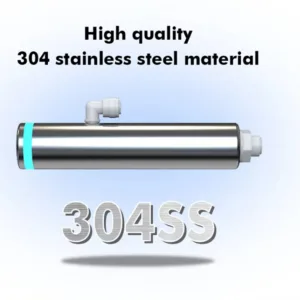
Stainless steel
Aluminum
PPR
ABS and engineering plastics
Water pressure
Pipe size
Thread type
Inlet and outlet direction
Waterproof structure
Installation orientation
Available product space
Different applications require different materials and pressure ratings.
Customers should provide the expected working pressure and installation environment before the final structure is selected.
System Validation and Performance Claims
A UV lamp or UVC LED module alone does not guarantee a specific disinfection rate in every water-treatment system.
Final performance depends on factors including:
Target microorganism
Wavelength
Delivered UV dose
Flow rate
UVT
Water quality
Reactor geometry
Exposure time
Optical distribution
Operating conditions
Performance claims such as a specific microbial reduction rate should therefore be supported by testing under defined conditions.
For new OEM products, prototype testing and final-system validation are recommended before mass production.
For U.S. projects requiring third-party certification, requirements such as NSF/ANSI 55 should be evaluated for the finished water-treatment system.
UVC Safety in Water Treatment Equipment
UVC light should remain enclosed inside a properly designed treatment chamber during normal operation.
Direct exposure to UVC radiation can be harmful to the eyes and skin.
Depending on the equipment, safety features may include:
Enclosed UV chamber
Light shielding
Safety interlock
Automatic shutoff
Leak protection
Status monitoring
Warning labels
The final equipment manufacturer should evaluate the complete product for electrical, optical, mechanical and water-contact safety.
Custom OEM & ODM UV Water Treatment Systems
As a factory, YOYO-UV provides OEM and ODM UV water treatment solutions for equipment manufacturers, distributors and product developers.
Customization can include:
UVC wavelength
UV output
Flow rate
12V or 24V input
Water pressure
Module size
Water inlet and outlet
Housing materials
PCB and LED layout
Flow sensors
Wiring and connectors
Waterproof design
Mechanical structure
Private-label production
We support projects from prototype development and sample testing to volume production.
What Information Do We Need for an OEM Project?
To recommend the right UV lights for water treatment, please provide:
Target application
Water source
Required flow rate
Water pressure
Available installation space
Pipe or connection size
Input voltage
Desired UV wavelength
Required treatment performance
Continuous or intermittent operation
Water quality or UVT, if available
If some parameters are not yet known, simply tell us what equipment you are developing and how the water flows through it.
Our engineers can help recommend a suitable starting design.
Whether you need a compact UVC LED water disinfection module, a low-voltage UV water sterilizer, an RV water-treatment unit or a customized OEM UV water treatment system, YOYO-UV can develop the UV light source and mechanical structure around your product requirements.