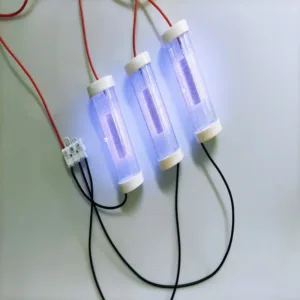
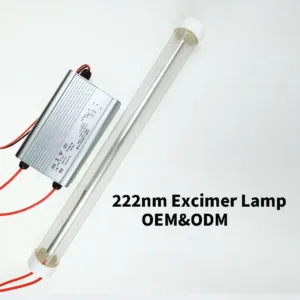
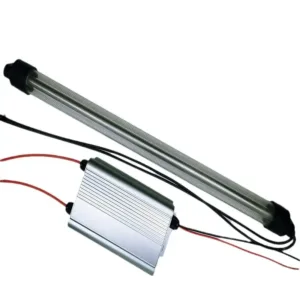
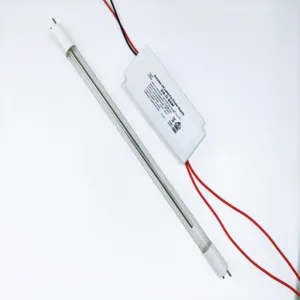
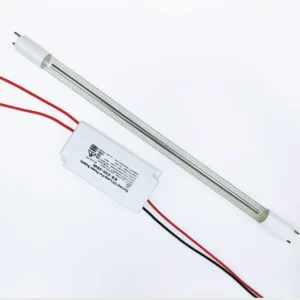
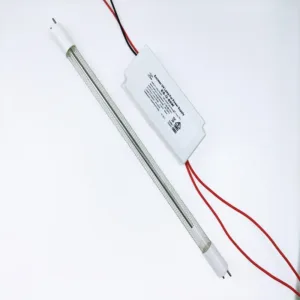
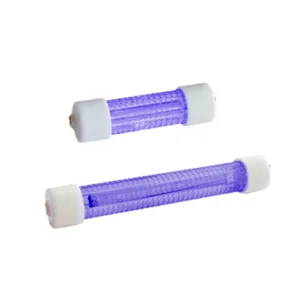
YOYO-UV offers a series of Far UVC 222nm lampsfor air-treatment equipment, HVAC, enclosed surface treatment systems, scientific equipment and OEM equipment.
Our products include compact and high-power 222nm excimer lamps of different dimensions, power and electrical specifications. The models are offered in compact low-power, 20W, 30W, 60W, 100W and 150W designs.
OEM and ODM service is provided to equipment and system manufacturers, distributors and OEM developers. The lamp dimensions, power, input voltage, mounting construction, driver, optical filtering, housing and other mechanical or electrical aspects can be customized to match the project.
What is Far UVC?
Far UVC usually refers to ultraviolet radiation in the short end of the UVC spectrum.
In commercial germicidal equipment, one of the widely studied Far UVC wavelengths is 222nm.
The vast majority of commercial Far UVC systems uses a krypton chloride (KrCl) excimer lamp.
The lamp produces a sharp peak around 222nm.
Unlike conventional 254nm UVC, the 222nm radiation has very limited penetration into biological tissues due to strong absorption by proteins and other biological molecules near the skin surface.
This does not mean, however, that any lamp advertised as “222nm” is inherently safe to use in any human exposure situation.
All these factors should be taken into consideration when designing Far UVC products.
Filtered 222nm Far UVC
Optical filtering is one of the most crucial elements of a professional Far UVC system.
The KrCl excimer lamp produces a major output around 222nm, but minor outputs outside of this wavelength range can also be produced.
The long-wavelength output is especially important because it has greater penetration into biological tissues than 222nm radiation.
For systems intended to operate in an occupied space, a proper optical bandpass filter can be applied to cut off all unwanted wavelengths and pass only the desired Far UVC output.
This is why engineers should not assess the Far UVC lamp based on its “222nm” labeling only.
Information to pay attention to includes:
Peak wavelength
Complete spectral distribution
Optical filter specification
Spectral irradiance
Irradiance at the target point
Measurement distance
Exposure time
Total radiation dose
Professional evaluation of a Far UVC lamp involves spectral measurements.
Far UVC and Human Exposure
Filtered 222nm Far UVC has been studied extensively due to the much lower penetration of this radiation into the outer layers of the skin and eye than conventional germicidal UVC.
This has led to a strong interest in developing properly engineered Far UVC systems for occupied spaces.
However, “Far UVC” does not imply an unrestricted human exposure by itself.
Occupational or photobiological safety guidelines should still be followed.
The maximum exposure allowed depends on the wavelength and the complete spectral output of the radiation source.
The Far UVC equipment should be therefore evaluated as a complete system, not by its labeling alone.
222nm Far UVC vs 254nm UVC
222nm Far UVC and conventional 254nm UVC are ultraviolet technologies used for microbial control applications, but they utilize different light sources and should be developed using different engineering approaches.
254nm systems usually use low-pressure mercury lamps.
222nm systems usually use KrCl excimer lamps.
Differences between the two can include:
Light-source technology
Spectral output
Human exposure limits
Optical filtering
Lamp efficiency
Startup behavior
Size
Maintenance requirements
Application environment
Conventional 254nm UVC remains a mature technology for water treatment, HVAC and controlled disinfection systems.
Filtered 222nm Far UVC becomes especially interesting when engineers want to study microbial reduction in an occupied or frequently occupied environment.
Far UVC for Air Treatment
Air treatment is one of the most actively studied applications for 222nm Far UVC.
Far UVC fixtures can be designed to irradiate room air or moving air in an engineered system.
Applications can include:
HVAC equipment
Air purifiers
Upper-room systems
Ceiling fixtures
Commercial buildings
Health care environments
Laboratories
Cleanrooms
Offices
Schools
Transportation environments
In air treatment equipment, power rating of the lamp is not the only parameter that determines the performance of the system.
Some of the design parameters include:
Room or duct dimensions
Airflow
Air velocity
Lamp position
Beam distribution
Irradiance
Exposure time
Desired UV dose
Reflective surfaces
Position of the occupants
The final system should be measured and validated under its operating conditions.
Far UVC for Surface Treatment
222nm lamps can also be integrated into surface treatment systems.
Applications can include:
Laboratory equipment
Enclosed processing systems
Industrial work areas
Packaging equipment
Cleanroom equipment
Commercial sanitizing systems
Surface treatment is largely determined by the line-of-sight.
Shadows, distance, shape of the objects and lamp angle affect the delivered UV dose.
This means that powerful lamp cannot guarantee even coverage of all surfaces.
When developing OEM equipment, the lamp position and optical geometry should be designed for the target surface.
Understanding Electrical Power and UV Output
Electrical power and Far UVC optical output are not the same specifications.
Lamp with the power of 20W, 60W or 100W does not necessarily produce the same amount of watts of useful 222nm radiation.
Electrical power is partially converted into heat and other optical output.
When professionally evaluating the Far UVC lamp, consider specifications like:
Electrical power
Peak wavelength
UV irradiance
Measurement distance
Spectral distribution
Beam angle
Operating temperature
When comparing two Far UVC lamps, their electrical power is not sufficient.
UV Irradiance and Measurement Distance
UV irradiance is usually specified in units of μW/cm² or mW/cm².
Irradiance value is always accompanied by measurement distance.
For example:
500 μW/cm² at 20cm
Is a far more meaningful engineering specification than
500 μW/cm²
Same lamp provides different irradiance at different distances.
Reflectors, optical filters, orientation of the lamp and design of the fixture change the distribution of UV energy.
When designing OEM equipment, specify the intended working distance and treatment area whenever possible.
UV Dose and Exposure Time
UV dose (sometimes called radiant exposure or fluence) depends on UV energy delivered over a certain period of time.
A simple relation is:
UV dose ≈ irradiance × exposure time
This relation is important for both microbial treatment and human exposure.
Stronger lamp operating for a shorter period of time may deliver the same dose as a weaker lamp operating for longer time.
For air treatment systems, airflow and retention time also influence the dose.
For surface systems, distance and exposure duration affect the dose.
This is why a Far UVC product should not be chosen based on the lamp wattage alone.
Optical Filters and Spectral Quality
For professional 222nm Far UVC systems, the optical filter should be considered an integral part of the light source, not an additional item.
A proper filter reduces unwanted wavelengths outside of the desired Far UVC range.
It becomes especially important when the system will be used in proximity to humans.
When developing OEM products, consider:
Filter material
Spectral transmission characteristics
Rejection of long-wavelength radiation
Operating temperature
Aging
Spacing of the lamp and filter
Mechanical installation
Filter should be mechanically and optically stable during the entire operational lifetime of the device.
Ozone and Indoor Air Chemistry
Far UVC equipment should also be evaluated for its influence on the indoor air.
Short wavelength UV radiation can interact with the oxygen and other molecules in the environment.
The exact effect of ozone generation or other chemical processes depends on the spectral output of the lamp, filtration, ventilation, room air chemistry and other conditions.
This is why one should not assume that each 222nm lamp generates no ozone.
When developing occupied space equipment, ozone generation and other indoor-air processes should be evaluated for the complete fixture and installation.
Lamp Lifetime and Output Maintenance
When evaluating Far UVC lamp lifetime, it is not sufficient to look at its ability to turn on.
More important is how much 222nm output remains during operation.
For professional equipment, lamp lifetime specification ideally should include:
Operational hours
Remaining UV output
Switching cycle
Ambient temperature
Driver conditions
Lamp orientation
A lamp can continue glowing with visible radiation even if the usable 222nm output has significantly decreased.
Output monitoring may therefore be required for critical applications.
222nm Measurements and Test Equipment
Far UVC measurement requires special test instruments that are capable of measuring the wavelength.
The meter capable of measuring conventional 254nm UVC does not necessary provide accurate measurements at 222nm.
For engineering evaluation of the lamp, the equipment can include:
Calibrated 222nm radiometer
Spectroradiometer
Optical power measurement equipment
Ozone monitor
Temperature monitor
Spectroradiometer is especially valuable when evaluating complete spectral output and performance of the optical filter.
Far UVC for Occupied Spaces
One of the reasons for growing interest in the filtered 222nm Far UVC technology is the possibility of using it in occupied spaces.
However, one cannot install Far UVC lamp in an occupied room just because the product name says “Far-UVC 222nm”.
Professionally designing the occupied space Far UVC equipment requires considering:
Spectral filtering
Lamp mounting height
Beam orientation
Position of the human body
Irradiance at the eye level
Skin exposure
Operating schedule
Total exposure during one day
Safety limits of human exposure
In the case of fixed installations, modeling can be combined with irradiance measurements in situ.
Final human exposure should be evaluated at realistic positions of the people.
Far UVC for HVAC and OEM Equipment
When designing OEM equipment, Far UVC lamps can be integrated into custom systems, not used as general purpose bulbs.
Designs can include:
HVAC modules
Air purifiers
Ceiling fixtures
Air treatment equipment
Enclosed treatment chambers
Laboratory equipment
Automated sanitization systems
Custom development can include lamp mounts, optical filters, reflectors, driver systems, timers and housings.
Complete electrical, optical and mechanical design should be evaluated before production.
Emerging Far UVC Water Treatment Research
The 222nm technology is also being researched for water treatment applications.
Studies include microbial inactivation, advanced oxidation and degradation of selected contaminants.
Water treatment has, however, different engineering requirements from air and surface treatment.
Some of the important factors include:
UV transmittance
Water chemistry
Flow rate
Reactor geometry
UV dose
Optical path length
Byproduct formation
In commercial water treatment equipment, reactor should be validated rather than making assumptions based on air or surface treatment results.
How to Select a Far UVC Lamp
Before selecting the Far UVC 222nm lamp, consider:
Target application
Required wavelength
Filter requirement
Required irradiance
Measurement or working distance
Treatment area
Electrical power
Input voltage
Lamp dimensions
Continuous or intermittent operation
Required lamp lifetime
Operating temperature
Fixture geometry
Conditions of human exposure
Required safety regulations
In the case of occupied spaces, spectral data and human exposure calculations should be incorporated into the design.
If some of the parameters above are not known yet, specify the type of equipment, available space and application.
Our engineering team will help you develop the required configuration.
OEM & ODM Far UVC Manufacturer
YOYO-UV offers OEM and ODM Far UVC solutions for equipment manufacturers, system integrators, distributors and product developers.
Our 222nm excimer lamps offer a wide variety of compact and high-power configurations for various applications.
Customization can include:
222nm excimer lamp power
Lamp dimensions
Input voltage
Driver or ballast
Lamp mounting
Optical filter
Reflector
Beam distribution
Housing
Wiring
Connectors
Sensors
Control systems
Private labeling
We provide support from sample development to prototype and volume manufacturing.
Whether you need a compact 222nm Far UVC lamp, higher-power excimer lamp for HVAC system or custom Far-UVC module with filtration and mechanical integration, specify the dimensions, electrical requirements, working distance and target application.
Our engineering team will help design the Far-UVC solution for your equipment.