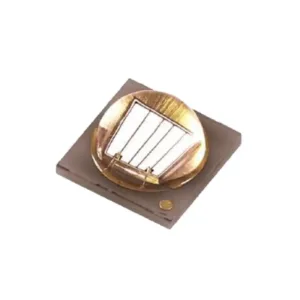
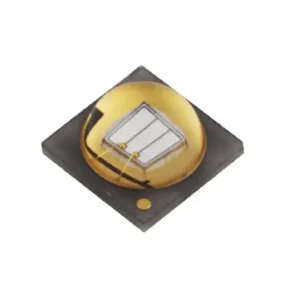
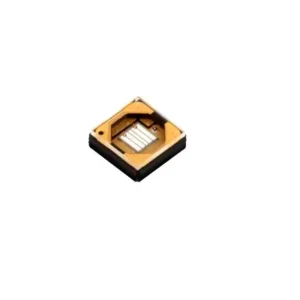
YOYO-UV offers UV light emitting diodes (UV LEDs) and develops custom UV LED modules and assemblies for industrial equipment, product development, research systems and OEM applications.
The YOYO-UV line of UV LEDs includes products with UVA, UVB and UVC wavelength ranges for various applications such as curing, fluorescence inspection, sensing, scientific instruments, phototherapy equipment development, water and air treatment, and other special applications with UV LEDs.
Depending on the product line, wavelength ranges include deep UVC, UVB and UVA LEDs from approximately 255nm to 395nm, as well as 405nm near-UV/violet LEDs. Individual UV LED components and assemblies with UV LED PCB mount, optics, heat sinks, wiring, connectors and other elements can be supplied.
OEM and ODM service is provided from prototype UV LED assembly to bulk manufacturing.
What is a UV Light Emitting Diode?
A UV light emitting diode is usually referred to as UV LED. It is a type of semiconductor light source intended for producing UV radiation.
Contrary to the traditional broad-spectrum UV lamp, a light-emitting diode is engineered around its own peak wavelength.
That is why UV LEDs can be very helpful in equipment where compact size, quick switching, wavelength selection and flexible mechanical integration are required.
The common grouping by wavelength of UV LEDs includes UVA, UVB and UVC LEDs.
However, a proper LED should be chosen according to the targeted material or application and not only based on electrical watts.
UVA, UVB and UVC LEDs
Each part of the UV spectrum is used for different purposes.
UVA LEDs
UVA LEDs with such wavelengths as 340nm, 365nm, 385nm and 395nm are the most popular.
Their applications include:
UV curing
Printing
Adhesive curing
Resin curing
Coating
Fluorescence inspection
Counterfeit detection
Security inspection
Oil leak detection
UV flashlight development
Insect attraction systems
365nm is a good choice when strong fluorescence excitation or a low level of visible violet light is needed.
385nm and 395nm wavelengths are the most used ones for industrial curing applications when the targeted ink, resin, coating or adhesive is sensitive to these wavelengths.
405nm LEDs are also commonly used in curing applications. Even though the 405nm wavelength could be regarded as near-UV/violet, it is commonly associated with curing UV LEDs in the market.
UVB LEDs
UVB LEDs with wavelengths like 295nm and 310nm and others (depending on the product family).
They can be used as a controlled light source for:
Scientific research
Spectroscopy
Biological analysis
Plant research
Laboratory irradiation
Phototherapy equipment development
A UVB LED component is not a finished medical device.
Phototherapy-related projects should be analyzed in detail in terms of wavelength accuracy, irradiance, exposure control, optical uniformity, thermal conditions and regulations.
UVC LEDs
Deep UV and UVC LEDs with wavelengths such as 255nm, 265nm and 275nm.
They can be applied to professional systems for:
Water treatment
Air treatment
Surface disinfection equipment
Analytical instruments
Fluorescence analysis
Scientific equipment
Water purifier development
OEM disinfection systems
LED wavelength or radiant power does not necessarily mean that a specific microbial reduction is guaranteed.
Disinfection performance depends on delivered UV dose, exposure time, geometry, target microorganism and operating conditions. Such testing should be done with respect to the complete finished system.
UV LED, UV LED Chip and UV LED Module: What Is the Difference?
These terms are often used simultaneously, but they do not always refer to the same product.
A UV LED or UV light emitting diode is an individual semiconductor light source.
A UV LED on PCB is a combination of the LED and a circuit board that serves as a base for electrical connections and thermal transfer.
UV LED Module can be defined as a set of one or more LEDs, PCB, wiring, connectors, optical lenses, heat sink, housing and other components for integration into equipment.
Individual UV LED components or assemblies of LEDs can be supplied by YOYO-UV according to OEM’s project.
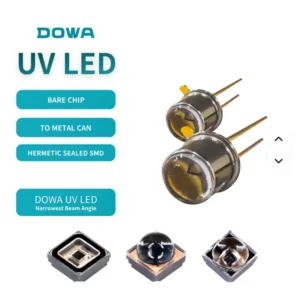
SMD, COB, TO-Can and Custom UV LED Packages
UV LEDs can be found in different packages.
The most common options include:
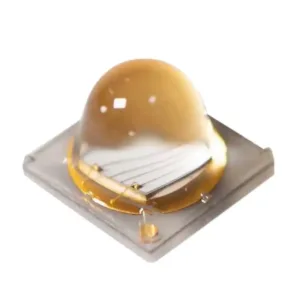
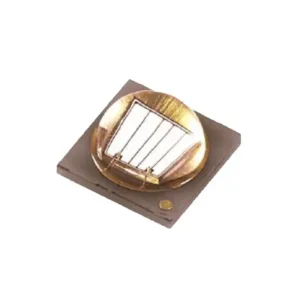
SMD UV LEDs
High-power SMD LEDs
TO-can UV LEDs
COB UV LEDs
UV LED star boards
Single-LED PCB modules
Multi-LED arrays
Linear UV LED boards
Custom UV LED assemblies
SMD package may be preferred when compact size and automated PCB assembly are the key requirements.
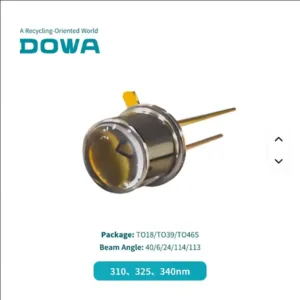
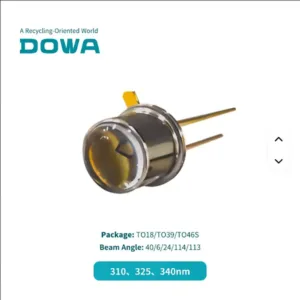
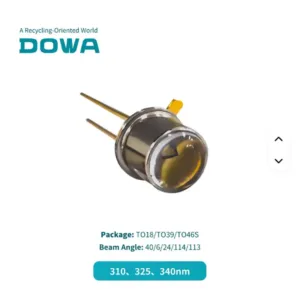
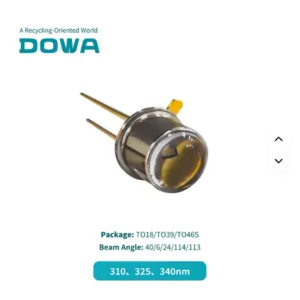
TO-can package could be preferred in UVB, sensing, spectroscopy and laboratory applications, when there is a need for a robust package or specific light beam design.
COB or multi-LED arrays could be good for applications where high radiant power or large irradiation area is required.
The optimal package depends on LED wavelength, power, installation space and thermal aspects.
Radiant Power vs Electrical Power
One of the most significant technical characteristics for choosing a UV light emitting diode is the radiant power.
Electrical power and UV optical output are not the same.
For instance, forward voltage multiplied by forward current would give an approximation of an electrical input power of an LED.
This does not say anything about the amount of milliwatts of UV radiation the LED generates.
In case of UV applications, an engineer should pay attention to the following LED specifications:
Peak wavelength
Radiant power or radiant flux
Forward voltage
Forward current
Viewing angle
Thermal resistance
Package size
While comparing two UV LEDs, the only parameter you cannot rely on is electrical wattage.
Peak Wavelength and Wavelength Tolerance
Wavelength indicated in the product name is typically a nominal or average value.
An LED with a 365nm wavelength might have another peak wavelength range, depending on the particular part number and manufacturer.
Such an aspect is critical for applications where the wavelength should be accurately known, like fluorescence, sensing, photochemistry and curing because the targeted material could react differently for small wavelength variations.
In order to ensure the proper wavelength range, it is always necessary to refer to the original LED data sheet.
An OEM project can be evaluated in terms of the required wavelength tolerance.
Forward Current and LED Drivers
Each UV LED should be driven according to electrical limits of the LED manufacture.
In general, a constant-current driver is used in order to control LED current.
An increased driving current will result in a higher radiant output of the LED but also increase its junction temperature and thermal load.
Exceeding of electrical or thermal limits may lead to instability or shortened life of the product.
Custom UV LED module can be developed taking into account LED electrical and thermal requirements.
Thermal Management for High Power UV LEDs
Thermal management becomes more important as power of UV LEDs grows.
Heat generated inside the LED has to be dissipated via the package, PCB and heatsink to the surrounding medium.
Full thermal management solution could include:
Aluminum PCB
Copper PCB
Ceramic substrate
Thermal interface material
Heatsink
Forced air cooling
Water cooling
The optimal solution depends on quantity of LEDs, their operating current, duty cycle, ambient temperature and installation space.
Therefore, a high-power UV LED should be evaluated as a complete thermal system and not as an independent semiconductor component.
Viewing Angle, Optics and Working Distance
Viewing angle is a parameter describing how light is emitted from the LED package, but it does not directly indicate the UV intensity at the target.
Irradiance of the target depends on several factors:
LED output + beam angle + optical lens + working distance + target area
Wide-angle UV LED is capable of providing a wider coverage area at a short working distance.
Narrower optics helps concentrate available UV energy on a shorter distance or a smaller irradiation area.
Custom UV equipment can be developed in terms of the irradiation area and working distance. We can help to select an LED layout and optics for the application.
UV LEDs for Curing and Printing
UVA and near-UV LEDs are widely used in curing systems.
Common wavelengths include 365nm, 385nm, 395nm and 405nm.
Applications include:
UV adhesives
Printing inks
Coatings
Resins
Electronics assembly
3D printing materials
Industrial bonding
The most appropriate wavelength depends on the photoinitiator or UV-sensitive material spectrum.
Therefore, the OEM equipment manufacture should test the LED with the material before the wavelength and power requirements are finalized.
UV LEDs for Fluorescence and Detection
UV LEDs are good in being used as a light source for excitation.
The applications could be such as:
Fluorescence inspection
Counterfeit detection
Security inspection
Mineral inspection
Forensic equipment
Oil leak detection
Spectroscopy
Optical sensing
Laboratory instruments
For fluorescence applications, wavelength selection is more important than electrical watts.
Excitation spectrum of the target material should be taken into account together with optical filters and detector sensitivity.
Custom UV LED PCB and Module Service
YOYO-UV can offer OEM and ODM UV LED module service for customers who require more than a simple LED component.
Customization could include:
UV wavelength
LED brand and model
LED quantity
Radiant output
PCB size
PCB shape
Aluminum PCB
Copper PCB
LED layout
Voltage and current
Wiring
Connectors
Optical lens
Reflectors
Beam angle
Heat sink
Cooling structure
Housing
UV LEDs could be installed on round, square, rectangular, linear or any custom-designed PCB depending on the end equipment.
We could develop multi-LED arrays and complete UV LED assemblies.
How to Choose a UV Light Emitting Diode
In case of OEM project, one should start from the application and not from the wattage.
The following parameters are the most informative ones:
Target wavelength
Radiant power requirement
Irradiance at the target
Working distance
Irradiation area
LED package size
Available PCB size
Input voltage
Operating current
Beam angle
Continuous or intermittent operation
Cooling conditions
Environmental requirements
If these parameters are unknown at the moment, the description of the application and available installation space would be enough to get started with the choice of a starting point of the UV LED module.
UV LED Safety and Final Product Design
UV radiation can be harmful for eyes and skin.
Danger depends on wavelength, intensity, distance and exposure time.
Therefore, the UV LED equipment should be developed in compliance with all safety requirements, including shielding, protective eyewear, enclosed light paths, safety interlocks, automatic shutoff and warning labels.
Do not look directly into the high-power UV LED.
For UVC, UVB and high-power UVA LEDs the final equipment manufacturer should evaluate photobiological safety and other relevant product requirements.
OEM & ODM UV LED Solutions
YOYO-UV provides UV LED components made by leading UV LED manufacturers and offers custom PCB assembly and OEM/ODM UV LED module development for industrial customers.
Our product range includes UVA, UVB and UVC LEDs of different wavelengths, packages, powers and beam angles.
We can assist in developing UV LED products from selection and UV LED prototype assembly to custom PCB design and manufacturing of UV LED modules in bulk volumes.
From 365nm UV LED diode for curing, 310nm UVB LED light source, 275nm UVC LED emitter, custom UV LED star boards to high-power multi-LED arrays, tell us the wavelength, output, size and application. Our engineering team will help to develop a UV LED module around your equipment.