Introduction
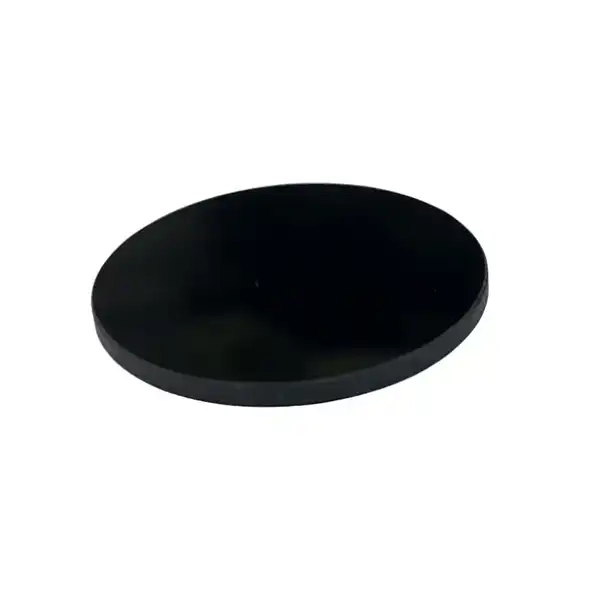
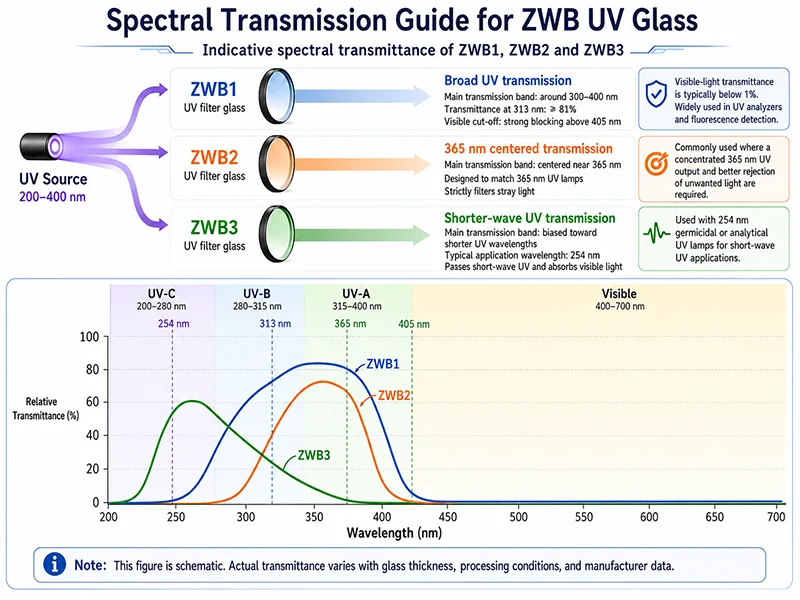
ZWB filter is a series optical glass which transmitted ultraviolet light and block visible lights. ZWB filter glass typically appears black. Different ZWB models are available for transmitting specific ultraviolet bands, including UV-A (long-wave ultraviolet), UV-B (medium-wave ultraviolet), and UV-C (short-wave ultraviolet).
The three common types are ZWB1, ZWB2, and ZWB3.
| Model NO. | Thickness(mm) | 254nm | 280nm | 313nm | 334nm | 365mn | 405nm | 700nm | date |
| ZWB1 | 1 | ≥50.0 | ≥81.0 | ≤1.0 | ≤30.0 | ||||
| ZWB2 | 1 | ≥38.0 | ≥80.0 | ≤8.0 | ≤14.0 | ||||
| ZWB3 | 2 | ≥34.0 | ≥86.0 | ≤28.8 | ≤64.6 |
What Is a ZWB Filter?
A ZWB filter is an ultraviolet-pass and visible-light-cut filter.
It often looks black, dark blue, or dark purple. The glass looks dark because it absorbs much of the light that people can see.
A ZWB filter can:
- Pass a chosen UV range
- Reduce visible blue and violet light
- Improve fluorescence contrast
- Clean the output of a UV lamp
- Help a sensor measure UV more clearly
The filter often placed in front of a UV LED, ultraviolet lamp, camera lens, or detector.
A light source filter and a camera filter may need different designs. A lamp filter must handle heat. A camera filter must also control infrared light.
How Does ZWB Filter Glass Work?
Most ZWB filter glass works by absorption.
Metal ions and other materials inside the glass absorb unwanted wavelengths. Selected UV wavelengths pass through.
Thickness changes the result.
A thicker filter may block more visible light. It may also lower useful UV output and become hotter. A thinner filter may pass more UV, but it may also pass more stray light.
This is why “thicker is better” is not always true. Tests with 2mm ZWB2 glass show that the filter can absorb part of the useful 365nm output and become warm in a high-power UV lamp.
Some ZWB glass also has an infrared leak. Human eyes cannot see this light, but a camera sensor may record it.
UV photography may need a second IR-cut filter.
ZWB1 vs ZWB2 vs ZWB3
The three types have different UV transmission bands.
Supplier data is not always the same. Some catalogs place ZWB1 near 313nm, ZWB2 near 365nm, and ZWB3 near 334nm. Other sellers offer ZWB3 grades for 254nm use.
The measured curve is more important than the product name.
| Type | Common Use | Main Point |
| ZWB1 | UV analysis, imaging, and fluorescence work | Often used for a shorter UV band than ZWB2 |
| ZWB2 | 365nm UVA lamps and flashlights | Reduces visible blue and violet light |
| ZWB3 | Special short-wave or mid-UV systems | Exact band must be checked with test data |
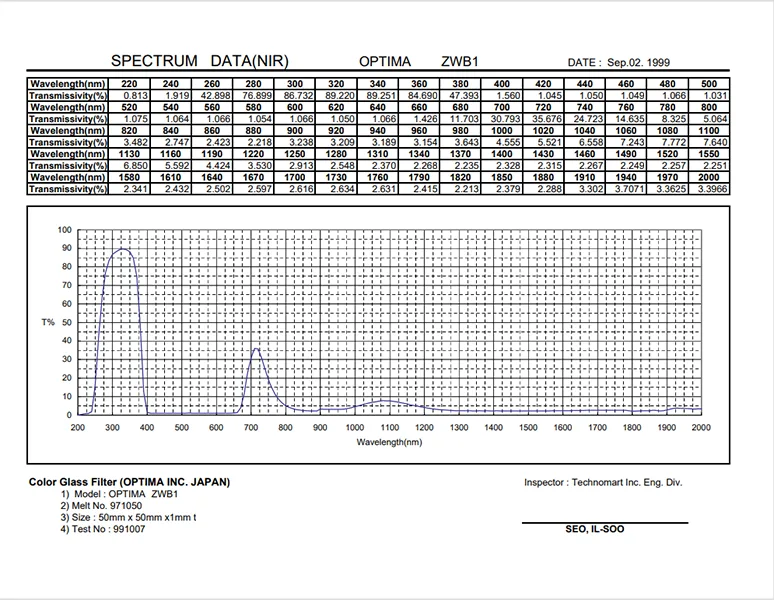
ZWB1 Filter
A ZWB1 filter may be used for UV analysis, imaging, and lab tools.
It can pass a shorter UV range than a common 365nm filter. It may also have a near-infrared leak.
Check these items:
- Transmission at your exact wavelength
- Test thickness
- Visible-light blocking
- Infrared transmission
- Batch test report
ZWB2 Filter
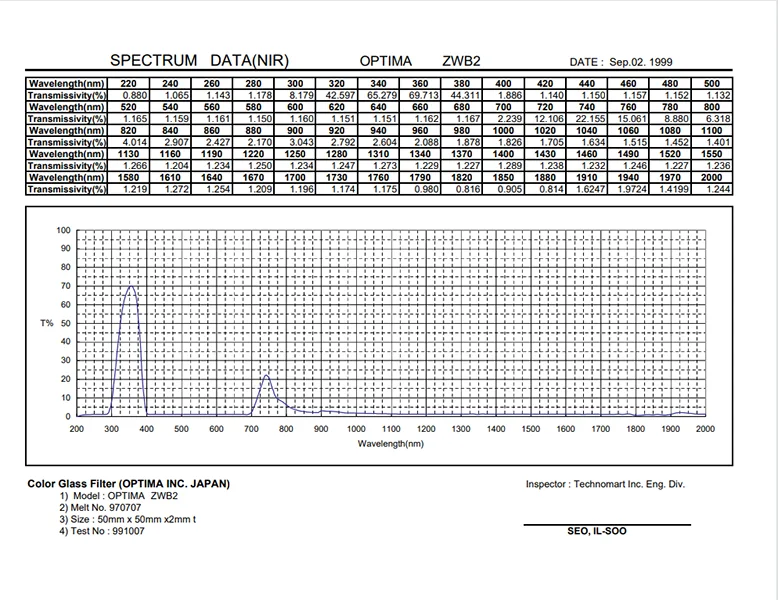
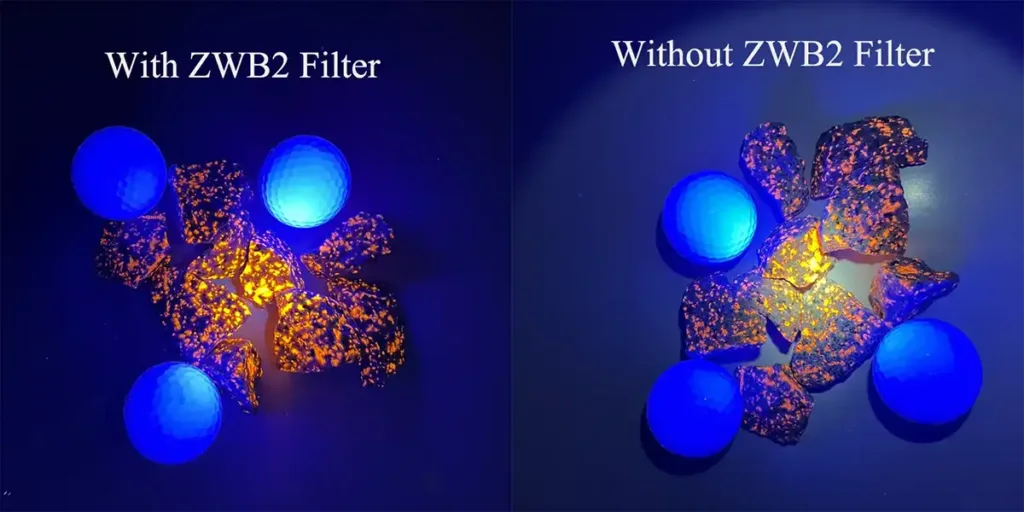
ZWB2 is a special UV-pass, cut most visible light optical glass engineered specifically for ultraviolet applications.
• Allows UV-A wavelengths (around 365nm) to pass through
• Absorb most visible light from 380–500nm
• Eliminates the “white glow” often seen in unfiltered UV flashlights or other uv light devices
ZWB2 is useful for:
Mineral hunters & collectors
UV photographers
Industrial inspectors
Security & law-enforcement
Document verification teams
Art restorers
Resin/adhesive professionals
HVAC technicians & leak detection
Hotel cleanliness inspectors
The filter also absorbs some useful 365nm light. High-power lamps may heat the glass.
Leave enough space for cooling. Test the filter during long use.
ZWB3 Filter
ZWB3 is used for a different UV band.
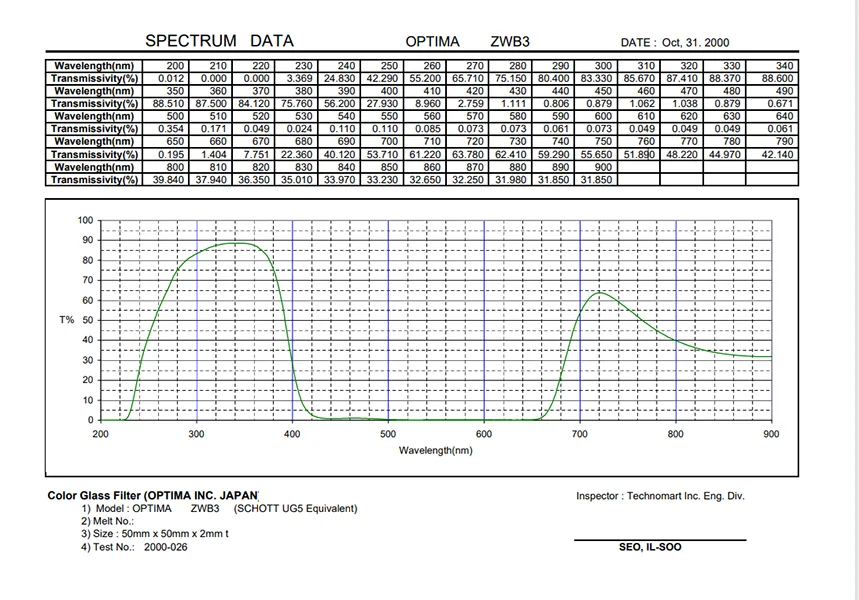
However, supplier catalogs do not always agree on its peak wavelength. Some list it near 334nm. Others market a ZWB3 filter for 254nm short-wave UV.
Do not order only by the name “ZWB3.”
Ask for measured transmission at 254nm, 265nm, 275nm, 313nm, or any other wavelength used by your system.
How to Read a ZWB Filter Transmission Curve
A transmission curve shows how much light passes through the glass.
The bottom line shows wavelength in nanometers. The side line shows transmission in percent.
Check these seven points:
- Target wavelength: Find your LED or lamp peak.
- Transmission value: Read the percent at that exact wavelength.
- Passband: Check the full useful UV range.
- Visible leak: Review the curve from about 400 to 700nm.
- IR leak: Review the curve above 700nm for camera use.
- Thickness: Make sure the curve uses the same thickness you plan to buy.
- Test details: Look for the instrument, batch number, date, and coating status.
A high peak does not mean the filter is right. The peak may not match your UV source.
Common Applications of ZWB Filters
UV Fluorescence Detection
A ZWB filter removes visible stray light from the UV source.
This gives a darker background and better contrast. It helps users see fluorescent minerals, dyes, inks, glue, and hidden marks.
UV Inspection Lamps
ZWB2 glass is often fitted to 365nm lamps.
It can improve inspection results in leak detection, document checks, cleaning checks, and industrial quality control.
UV Imaging and Photography
A ZWB filter can placed in front of the light or camera.
For camera use, check infrared leakage. A filter that looks black may still pass IR. A filter stack may be needed.
Laboratory Instruments
Common uses include fluorescence readers, optical sensors, UV analyzers, gel imaging tools, and scientific test systems.
For accurate work, request a report from the same production batch as the order.
Short-Wave UV Systems
Short-wave UV may include 254nm, 265nm, and 275nm.
Not every ZWB filter passes these wavelengths well. Check the real curve.
Also make sure the glass, coating, seal, and holder can handle the UV source.
UV-C can harm eyes and skin. Use a closed system, safety shield, and interlock.
How to Choose the Right ZWB Filter
Follow these steps:
- State the exact wavelength, such as 365nm ±5nm.
- Set the minimum UV transmission you need.
- Define the visible and infrared blocking range.
- Compare more than one thickness.
- Give the exact size, shape, and tolerance.
- Check heat, moisture, and working time.
- Test a sample in the real device.
- Approve the batch only after checking the report.
For a camera project, send the camera model and sensor range.
For a lamp project, send the LED model, power, distance from the filter, and cooling method.
Custom ZWB Filter Specifications
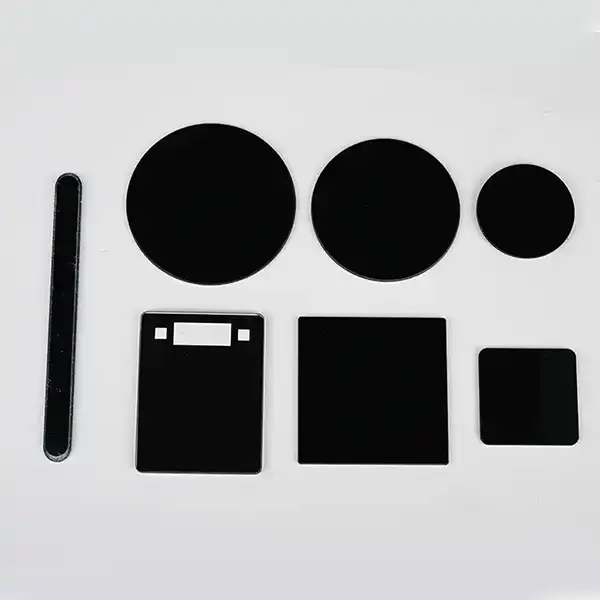
A custom ZWB filter can be made as a round disc, square plate, rectangle, or special shape.
Common custom items include:
- ZWB1, ZWB2, or ZWB3 glass
- Diameter, length, and width
- Thickness
- Surface quality
- Flatness
- Clear aperture
- Edge grinding or chamfer
- Anti-reflection coating
- Mounted filter holder
- Spectral test report
The best specification depends on the use. A flashlight lens does not need the same flatness as a lab imaging system.
Handling and Safety
Wear clean gloves when you handle the glass.
Keep the optical area free from fingerprints and dust. Use lens tissue and a safe optical cleaner. Do not use rough cloth or hard tools.
Replace glass with cracks or deep edge chips.
A dark ZWB filter is not safety eyewear. It may pass strong UV even when the light looks dim.
Use certified UV safety glasses for the correct wavelength.
Frequently Asked Questions
What does a ZWB2 filter do?
It passes much of the 365nm UVA band and cut visible blue and violet light. This can improve fluorescence contrast.
Which ZWB filter is best for 365nm?
ZWB2 is the common choice. Still, check the measured transmission at 365nm and the filter thickness.
Does a ZWB filter block all visible light?
No. A small leak may remain. The amount depends on glass type, thickness, batch, and wavelength.
Can I use ZWB2 with a 395nm light?
It is usually not a good match. A ZWB2 filter made for 365nm may reduce much of the 395nm output.
A true 365nm source is often better for filtered fluorescence work.
Does ZWB glass block infrared light?
Not always. Some grades pass near-infrared light. Camera systems may need an extra IR-cut filter.
Does ZWB filter thickness matter?
Yes. More thickness can improve blocking, but it can also reduce UV output and increase heat.
Can a ZWB filter be custom-made?
Yes. Size, thickness, shape, surface quality, edges, coating, and mounting can be customized.
Request a Custom ZWB Filter
To receive a useful quote, send:
- Target wavelength
- Light source model
- Required filter size
- Thickness
- Minimum UV transmission
- Visible or IR blocking needs
- Quantity
- Application
A good supplier should help you compare glass types and provide a measured curve or batch report.
This reduces risk and helps the ZWB filter work as planned.