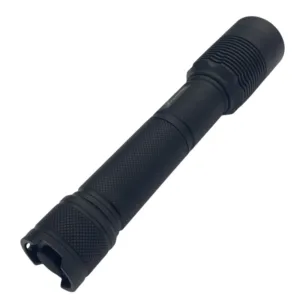
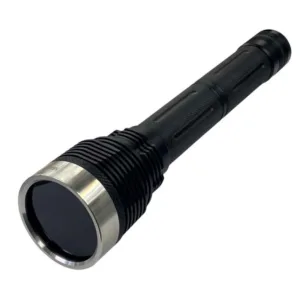
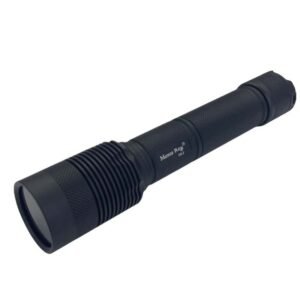
YOYO-UV offers and supplies UVB flashlights for fluorescent minerals inspection, scientific research, laboratory testing and specialized OEM applications.
Our portable UVB light sources include wavelengths like 295nm and 310nm, with custom UVB wavelengths and optics for selected projects.
We offer high-power and small UVB LED flashlights with customized LEDs, optical filters, reflectors, beam angles, batteries, drivers, thermal protection and flashlights.
As a factory, we offer OEM and ODM services for UVB flashlights for sample production and optical testing to OEM mass production.
What Is a UVB Flashlight?
A UVB flashlight is a portable ultraviolet light source working at UVB wavelengths.
UVB usually ranges from approximately 280nm to 315nm.
It includes wavelengths like:
295nm
308nm
310nm
311nm
Within the fluorescent-minerals industry, UV light at 310nm wavelength is known as midwave UV.
That is why the term 310nm UVB flashlight or 310nm midwave UV flashlight is sometimes used for the same portable UVB source.
295nm and 310nm UVB Flashlights
Different wavelengths of UVB can provide various optical effects from the same object.
Our main UVB flashlights can be 295nm and 310nm UVB LED flashlights.
295nm UVB Flashlights
A 295nm UVB flashlight works at a short end of the UVB wavelength range.
It can be a portable UVB light source for tests, research, optical experiments and specialized applications.
Since 295nm wavelength is much shorter than usual 365nm UVA blacklight, it is necessary to have stronger safety control and not to use it as a visible-light flashlight.
310nm UVB Flashlights
A 310nm UVB flashlight is a common midwave UV light source.
310nm is especially important in fluorescent minerals industry because some minerals react differently to midwave UV than to shortwave UVC or longwave UVA.
The typical applications include:
Fluorescent minerals identification
Geological work
Rock collection
Calcite inspection
Fluorite inspection
Laboratory experiments
Scientific research
Optical experiments
Fluorescence testing
Inspection of UV sensitive materials
In the case of minerals identification, the best wavelength depends on the sample itself. A sample which reacts well to 365nm light may behave differently with 310nm light and vice versa.
310nm Midwave UV for Fluorescent Minerals
UV fluorescence is an effect where a material absorbs UV light and emits visible light.
Different minerals have different activators, impurities and crystal structures and therefore they react differently to various UV wavelengths.
Therefore, a 310nm midwave UV flashlight can help to see the mineral reaction which cannot be seen with common 365nm longwave UV.
In order to properly identify the minerals, many people prefer to compare:
255nm shortwave UV
310nm midwave UV
365nm longwave UV
The multi-wavelength approach gives more information than single-wavelength flashlight usage.
UVB vs UVA vs UVC Flashlights
The UV flashlights are chosen by wavelength rather than brightness.
UVA flashlights around 365nm are commonly used for fluorescence inspection, leak detection, counterfeit checking and blacklight applications.
UVB flashlights around 295-311nm are more specialized products and are used for midwave UV fluorescence, research and specialized UVB applications.
UVC flashlights work at wavelengths below 280nm and require additional safety measures.
These products should not be considered interchangeable.
The proper wavelength depends on the target material and application.
Electrical Power vs UVB Radiant Output
Electric power and UVB radiant output are two different technical parameters.
For example, a flashlight called 5W UVB flashlight can work with 5W class LED or approximate electrical power consumption of 5W.
It doesn’t mean that the flashlight emits 5W of UVB optical radiation.
The professional UVB light sources should have clear distinction between:
Electric power
Radiant flux or radiant power
Peak wavelength
Irradiance
Measurement distance
Beam diameter
Radiant power is normally measured in milliwatts (mW) or watts (W) and is equal to the total optical output of UV radiation.
This parameter is more informative for the comparison than electric power.
Radiant Flux vs Irradiance
Radiant flux and irradiance are interrelated but not the same parameters.
Radiant flux describes the total UV radiation output of the light source.
Irradiance describes the UV radiation power that falls onto a defined area from the defined distance.
For this reason, the irradiance specifications should include a measurement distance.
For example:
5 mW/cm² at 10cm
specification gives more information than just:
5 mW/cm²
because there is no indication where this measurement has been done.
The reflector, beam angle, working distance and spot diameter affect the irradiance on the target.
Beam Angle and Working Distance
The optical design of a UVB flashlight determines how the UV energy is directed.
Narrow beam allows focusing more UV output into the smaller area while the wider beam covers the larger inspection area with less irradiance on the target.
Main optical parameters include:
Beam angle
Reflector diameter
Working distance
Spot diameter
Irradiance
Target area
If you need a custom OEM flashlight, then give us the required working distance and target area, so the reflector and optical design can be selected together.
UV Filters for UVB Flashlights
UVB LEDs can generate extra visible light or spectral output outside the main peak wavelength.
UV pass filter can minimize the extra light and increase the fluorescence contrast.
Various UVB flashlight designs can use different filter glass depending on the LED spectrum and target wavelength.
Therefore, the proper filter glass should be chosen based on its spectral transmission properties and not on the model name.
Main filter parameters include:
Transmission at the target UVB wavelength
Blocking of visible light
Out-of-band rejection
Filter thickness
Temperature tolerance
Mechanical parameters
The filter glass does not generate additional UV light.
It changes the spectrum by transmitting certain wavelengths and blocking the others.
As the filter glass has certain transmission losses, the LED and filter should be tested together.
Thermal Management for High-Power UVB Flashlights
Thermal management is especially important in a high-power UVB flashlight.
Not all the electrical power consumed by the LED becomes useful UV radiation. The rest of the power turns into heat in the LED, PCB, driver and flashlight body.
The professional design may include:
Copper or aluminum LED PCB
Aluminum flashlight housing
Thermal paste
Increased heat-sink surface
Temperature monitoring
Automatic current reduction
Low-voltage protection
The initial UV output immediately after turning the flashlight on can be different from the sustained output after heating the flashlight.
In the professional UVB flashlights, stable UV output for the entire operating time can be more important than a peak-power output.
Rechargeable UVB Flashlights
Portable UVB flashlights can be equipped with various types of rechargeable lithium-ion batteries.
They include:
18650
21700
26650
Custom battery packs
The correct battery configuration depends on the LED voltage, operating current, required runtime and flashlight size.
The battery capacity alone does not define the runtime.
The actual runtime depends on:
UV LED power
Driver efficiency
Operating mode
Thermal regulation
Battery voltage
Temperature
For high-output UVB flashlights, battery and thermal design should be developed together.
UVB Flashlights for Scientific and Laboratory Applications
Portable UVB LEDs can be used as a controlled excitation source in professional devices.
Possible applications can include:
Optical experiments
Scientific research
Fluorescence experiments
Photochemical experiments
Material testing
Laboratory equipment
Spectroscopy equipment
Custom UV testing equipment
In the scientific applications, wavelength accuracy is more important than electric power.
Customers should specify the required peak wavelength and wavelength tolerance for choosing the LED.
308nm and 311nm UVB Light Sources
308nm and 311nm UVB wavelengths can be used in special professional equipment.
In particular, narrowband UVB at 311nm wavelength is related to medical phototherapy equipment.
However, the UVB LED or handheld flashlight is not a phototherapy device.
A finished medical product requires irradiance control, treatment area, exposure time, dose calculations, beam uniformity, protection and regulatory evaluation.
YOYO-UV can provide UVB LED components and custom light-source development for professional equipment manufacturers.
Any medical claims, treatment protocol and regulatory evaluation should be performed for the final medical product.
How to Measure a UVB Flashlight
UVB characteristics should be measured with instruments suitable for the wavelength of interest.
Depending on the project, possible measurements can include:
Spectral peak
Wavelength distribution
Radiant flux
Irradiance
Beam diameter
Surface temperature
Runtime
Output stability
The radiometer should have suitable spectral sensitivity for the measured wavelength.
For precise wavelength analysis, the spectrometer or spectroradiometer gives more information than a simple UV meter.
The measurement distance, operating current and other conditions should always be measured for correct results comparison.
UVB Flashlight Safety
UVB radiation can cause eye damage and skin burn.
A UVB flashlight should therefore be considered as a professional ultraviolet source and not a simple flashlight.
The key safety practices include:
Never looking into the operating LED
Never pointing the beam on the person or animal
Avoiding direct exposure of skin
Using appropriate UV-blocking protective eyewear
Keeping the product out of reach of children
Using controlled activation if possible
Including the proper warning labels and instructions
For professional or OEM products, the photobiological safety evaluation should be done based on the wavelength, irradiance, exposure conditions and intended use.
Custom OEM & ODM UVB Flashlights
YOYO-UV provides OEM and ODM UVB flashlight manufacturing services for UV equipment manufacturers, mineral suppliers, laboratories, distributors and professional product developers.
Customization options can include:
295nm UVB
310nm UVB
Custom UVB wavelengths
UV LED brand and model
Radiant output
LED quantity
UV filter
Reflector
Beam angle
Spot diameter
Working distance
Copper or aluminum LED PCB
Driver current
Thermal protection
Battery type
Charging system
Aluminum housing
Operating modes
Waterproof structure
Switch
Logo
Packing
We assist in development from LED selection and sample assembly to optical testing and mass production.
What Information Do We Need for a Custom UVB Flashlight?
For development of a custom UVB flashlight, please provide:
Required wavelength
Target application
Required radiant output or irradiance
Working distance
Target spot diameter
Filter requirement
Battery type
Required runtime
Flashlight dimensions
Operating mode
Waterproof requirement
Quantity
If these parameters are not yet known, then please give us the material or equipment the UVB flashlight will be used with.
Our engineers can recommend the appropriate UVB LED, optical filter, reflector, driver and thermal design for prototyping.
Whether you need a 295nm UVB flashlight, 310nm midwave UV flashlight for fluorescent minerals or any other custom handheld UVB light source for professional equipment, YOYO-UV can develop OEM and ODM UVB flashlights from sample production to mass manufacturing.